Ultrasound biopsy needle guides: getting compatibility right
A needle guide only works with the probe it was designed for. What to check before you order guides for transrectal, transvaginal or transperineal procedures: probe model, needle gauge, biopsy line and sterility.
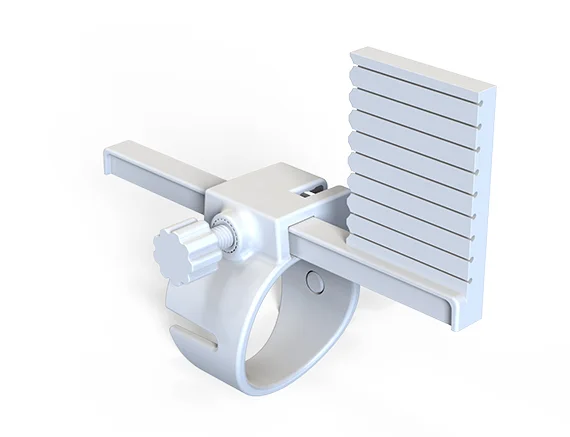
A needle guide clips onto an ultrasound probe and holds the needle on a fixed path, so that the needle appears along the biopsy line drawn on the ultrasound screen. Each guide is shaped for one probe housing and one needle path. A guide that sits loosely on the probe, or a biopsy line that does not match the guide, puts the needle somewhere other than where the operator expects it — which is why compatibility deserves more attention than it usually gets.
Three kinds of procedure, three kinds of guide
- Endocavity guides (transrectal and transvaginal) attach along the shaft of an endocavity probe. They are used for transrectal prostate biopsy, transvaginal biopsy and oocyte retrieval.
- Transperineal guides are used for prostate biopsy and other procedures through the perineum. Traditional set-ups use a stepper and a grid template; freehand guides attach directly to the probe and let the operator change the needle position without a stepper or stabiliser.
- Abdominal and superficial guides attach to convex or linear probes for biopsies of the liver, kidney, thyroid, breast and other organs.
1. Identify the exact probe model
Guides are made for a probe model, not for an ultrasound brand: two probes from the same manufacturer can have completely different housings, and one guide can fit probes of several brands that share a housing. Read the model designation on the probe connector or cable label, or in the probe menu of the ultrasound system, and give it to your supplier exactly as written.
Manufacturer names change over time — BK Medical is now part of GE HealthCare and Toshiba probes are sold under the Canon name — so a probe may be listed under either name. When in doubt, send photos of the probe head from the side and from above together with its label: the shape of the housing is what the guide has to fit.
2. Match the needle gauge and length
Each guide has a channel for a range of needle diameters. Check the range for every needle you plan to use — biopsy needles, coaxial introducers and aspiration needles — and remember that a lower gauge number means a thicker needle. Our transperineal guides, for example, accept 15G to 17G coaxial needles and 16G to 18G biopsy needles, while our endocavity guides are made for 16G to 18G instruments.
Check the length as well. The needle has to reach the target after passing through the guide, so the usable length is shorter than the length printed on the needle pack.
3. Set the biopsy line on the ultrasound system
The biopsy line on the screen is drawn by the ultrasound system for a specific guide and angle. Select the matching guide in the system's biopsy menu and use the angle setting that corresponds to the guide — some guides have a single fixed angle, others two or more. Before a new guide type is used on patients, many departments verify that the needle follows the displayed line, for example in a water bath, following the ultrasound manufacturer's instructions.
4. Single-use or reusable
Reusable stainless-steel guides must be cleaned and sterilised or high-level disinfected between patients exactly as their instructions state. Single-use sterile guides remove the reprocessing step and the risk of cross-contamination between patients. Single-use guides are often available in three configurations:
- needle guide only;
- needle guide with a sterile probe cover;
- needle guide with a probe cover and sterile ultrasound gel.
Kits reduce the number of items to stock, open and check in the procedure room.
5. Fusion biopsy and navigation
For MRI and ultrasound fusion-guided prostate biopsy, the probe carries a position sensor. Check that the guide leaves room for the sensor or provides a housing for it, and that the combination is supported by your fusion system.
6. Records to keep
For each guide type, keep the instructions for use, the manufacturer's list of compatible probes and the conformity certificates, and record the lot number used for each patient. These records are needed for traceability and for acting on any field safety notice.
Ordering guides from us
Our biopsy needle guides and transperineal needle guides fit probes from GE, BK Medical, Philips, Siemens, Canon (Toshiba), Samsung Medison, Mindray, Esaote, Hitachi and Aloka, SonoScape, Terason and other manufacturers; the product pages list the compatible probe models where the manufacturer specifies them. Send us the make and model of your probe — or photos of its label — and we will confirm the right reference, together with suitable biopsy needles.
Need advice on a specific model?
Our product specialists can compare options, confirm documentation and prepare a quotation.