Before you buy an electrosurgical generator: a practical checklist
Output power, modes, safety monitoring, accessories and service all affect what a generator can do in your theatre and what it costs to run. Twelve points to settle before you compare quotations.
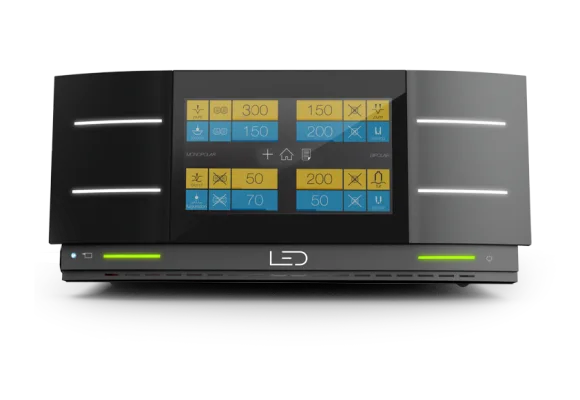
An electrosurgical generator stays in service for many years, and much of its running cost comes from the accessories it uses. Settling a few technical and practical questions before you compare quotations helps you avoid a unit that is under-powered for your procedures — or one that is specified far beyond what your theatre needs.
1. Start from the procedures
List the specialities and procedures the generator will support now and over the next few years: general and laparoscopic surgery, gynaecology, urology including transurethral resection, ENT, dermatology and plastic surgery, or minor procedures in an outpatient room. This list decides almost every other point below.
2. Monopolar and bipolar outputs
- Monopolar cutting and coagulation cover most open surgery. Check how many monopolar outputs the unit has and whether two surgeons can work at the same time.
- Bipolar is preferred close to nerves and in micro-surgery, and is the basis of bipolar resection in saline. Check whether bipolar output can start and stop automatically when the forceps touch and leave tissue.
- Simultaneous activation of monopolar and bipolar outputs is useful in larger theatres with two operators.
3. Maximum power, and how it is controlled
A higher maximum output is needed for monopolar transurethral resection and large-area cutting; dermatology, ophthalmology and minor surgery need much less. More important than the peak figure is how the generator regulates its output. Impedance-sensing power control adjusts the delivered power as tissue resistance changes, which keeps the surgical effect consistent and lets the surgeon work at lower settings with less lateral thermal spread.
4. The modes you will actually use
Compare cutting modes (pure cut and blend levels) and coagulation modes (soft, forced and spray) by what they do, not by how many there are. If you perform transurethral resection or hysteroscopy, check for dedicated modes for resection in saline or in non-conductive irrigation fluid.
5. Vessel sealing
Bipolar vessel sealing closes vessels without clips or ligatures. Ask for the maximum vessel diameter stated by the manufacturer, which sealing instruments are compatible, and whether they are reusable or single-use — this has a large effect on the cost per procedure.
6. Patient safety monitoring
- Return electrode monitoring with split (dual-area) patient plates, which stops the output when the plate loses contact with the skin — the main protection against burns at the plate site.
- Low capacitive coupling for laparoscopic and endoscopic work, where stray currents can cause injuries outside the field of view.
- Applied parts of type CF or BF as stated in the specifications, and conformity with IEC 60601-1 and with IEC 60601-2-2, the particular standard for high-frequency surgical equipment.
- Clearly audible activation tones and alarms, and a display of the active output and power setting.
7. Argon plasma and smoke evacuation
Argon plasma coagulation provides non-contact coagulation of large bleeding surfaces and is used, for example, in endoscopy and liver surgery. Some generators integrate an argon module; others control an external unit. Surgical smoke should be removed at source, so check whether the generator can switch a smoke evacuator on automatically during activation.
8. Accessories and connectors
List the pencils, electrodes, bipolar forceps, cables and patient plates you already use and confirm that their connectors fit. Ask for the price and availability of every single-use item you will need regularly, and calculate the cost per procedure, not only the price of the generator.
9. User interface and set-up
A clear display, stored programmes for each surgeon or procedure and simple footswitch configuration save time between cases and reduce setting errors. Ask for a demonstration with your own surgeons and theatre staff.
10. Installation, training and documentation
Installation should include an electrical safety test and a check of the output, recorded in a written report. Training for surgeons and theatre staff should cover the modes, patient plate placement and the meaning of each alarm. Ask for the instructions for use, the declaration of conformity and the UAE registration documents for the model.
11. Maintenance and testing
Generators need periodic electrical safety tests and output verification with an electrosurgical analyser at the interval the manufacturer specifies, commonly once a year. Ask who carries this out locally, how long a typical repair takes and whether a loan unit is available while yours is in the workshop.
12. Software and future options
Ask whether modes and functions can be added later by software update, and how updates are installed. A generator that can be upgraded is easier to keep in line with new procedures.
Generators in our range
Our range includes plasma electrosurgery and ligation systems such as the Surtron Touch HP 400/300 — two monopolar and two bipolar outputs, an integrated argon unit and vessel sealing for vessels up to 7 mm — and electrosurgical units for general and outpatient surgery. Send us your procedure list and we will propose a configuration together with the accessories you need.
Need advice on a specific model?
Our product specialists can compare options, confirm documentation and prepare a quotation.